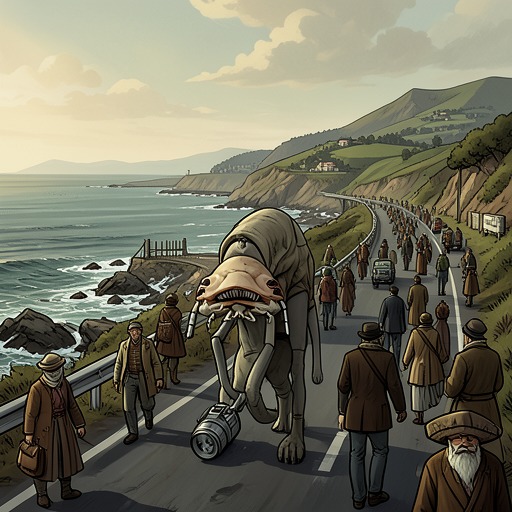
Habit and the disenchantment of place
In Search of Lost TimeHabit and the disenchantment of place is the process by which repeated experience drains unfamiliar landscapes of their initial mystery and gives them ordinary, practical meanings. Around Balbec, this change unfolds through etymological explanations, habitual journeys, and a growing network of acquaintances: a country first approached as an imaginative elsewhere becomes a familiar social territory, welcoming and soothing but less available to solitary wonder.
Names: From Imaginative Strangeness to Explanation
On journeys between Balbec and Douville, Brichot’s explanations alter the narrator’s response to the region’s place-names. At first, their sounds seem to contain particular, almost private enchantments. The narrator is charmed by the “flower” at the end of names such as Fiquefleur, Honfleur, Flers, Barfleur, and Harfleur, and amused by the “beef” in Bricqueboeuf. Etymology replaces these fanciful impressions with general meanings: fleur signifies a harbour, while boeuf, through Norman budh, means a hut. Bricqueboeuf becomes legible alongside Elbeuf, and a name that had seemed irreducibly individual is absorbed into a broader linguistic pattern.
Pennedepie makes the cost of explanation particularly clear. Its rough, distinctive sound had seemed to hold a history too obscure for reason to unravel; the discovery that pen means mountain, as in Penmarch and the Apennines, makes the name intelligible but less singular. Knowledge does not simply add information to an unchanged landscape. It alters the kind of attention the landscape can command, replacing a vivid private association with a reasoned category.
Routes: From Landscape to Social Circuit
The change reaches beyond words to the places they name. Saint-Pierre-des-Ifs had once brought back a melancholy first encounter and the prospect of an extraordinary view at sunrise, described to the narrator by Elstir. Later, the station’s name chiefly anticipates a conversation with a witty older acquaintance about Chateaubriand and Balzac. The cliff at Incarville likewise ceases to open onto an imagined distance: its sandstone wall becomes transparent in the narrator’s perception, revealing the comfortable house of an uncle of M. de Cambremer, where he can expect a warm welcome.
Other stations become coordinates in a habitual social itinerary. Doncières is where Morel joins the train; Egleville is where Princess Sherbatoff usually waits; Maineville is where Albertine gets off on fine evenings when she wants to spend a little longer with the narrator. Hermenonville, Harambouville, and Incarville no longer evoke the rugged grandeur of the Norman Conquest or the melancholy of the first evening. They are places where familiar people appear, exchange greetings, and punctuate the journey with a cordial handshake.
The railway helps turn distance into a chain of visits. Country houses lie close enough to the departmental line that their owners can hail passengers almost as if from a doorstep or bedroom window. Even a station where no greeting is heard has acquired a human meaning for the narrator: its silence suggests friends asleep in neighbouring houses who would welcome him if he needed their hospitality. The route that once heightened his loneliness now carries the assurance of acquaintances distributed along its length.
Familiarity as Comfort and Loss
This social familiarity changes the emotional character of the country. The narrator no longer fears the loneliness that seized him on his first evening in the region, nor feels like a homesick stranger. The train’s whistle separates him from one friend only to bring him toward another; the surrounding landscape becomes breathable because it is charged with human connection. Its former poetic call—the cries of nocturnal animals—is displaced by the greetings of M. de Criquetot and Brichot. The comfort is genuine, but the atmosphere can become almost too soothing.
The journey’s pleasures also draw the narrator away from the aesthetic pursuits that originally mattered to him. After a few months, the available hours of a new town no longer feel open and unclaimed. If time happens to become free, he is less likely to spend it visiting a church that first drew him to Balbec or comparing a landscape with a sketch by Elstir than to play another game of chess with M. Féré. The same country that once promised artistic discovery has become a place of routine visits and familiar diversions.
The Landscape’s Returning Strangeness
Habit does not erase every possibility of renewed perception. Before the country has become fully domesticated by routine, a spring road can still make the familiar radically strange. After escorting Albertine toward Epreville on a cold, rainy day, the narrator revisits the road he had travelled with his grandmother in August. The apple trees, now in full bloom, appear astonishingly luxuriant above the muddy ground; the sea gives them the background of a Japanese print, and the blue sky seems almost violent through their flowers. Rain then draws a grey veil across the horizon, while the blossoms remain aloft in the icy downpour. The changed season transforms a remembered route into a newly apprehended scene.
At another moment, the narrator’s ride through a wooded cliff road recalls Elstir’s watercolours and carries the landscape outside the ordinary world of the present. An aeroplane appears above him, a machine still rare in those days. Its sight moves him because it opens an imagined freedom of routes through space and life, opposed to the captivity of habit. The episode makes the tension explicit: habitual life narrows possibility, but a sudden encounter can make the world strange and expansive again.
Practical Knowledge and Changed Desire
The wider result is not simply a loss of beauty but a change in what the region means and what the narrator wants from it. At La Raspelière, carefully placed benches offer different “views” of Balbec, Parville, and Douville; from one, the sea is visible but inaudible, while from another its waves can be heard. Such arrangements show how a landscape can be encountered from successive, particular positions rather than as one abstract panorama. Yet as the narrator’s own life there settles into social habits, even these possibilities for looking are increasingly joined to practical routines and company.
On the return train, the names that once stirred his imagination have become familiar enough to consult in a timetable as calmly as entries in an address book. The narrator calls the country’s transformation both corrupting and charming: its geography still makes visits resemble journeys, yet those journeys have shrunk to the agreeable proportions of social calls. The transformation eventually reaches his private decisions. With the region experienced chiefly as a comfortable circuit of acquaintances, the idea of marrying Albertine appears to him to be madness. Familiarity has made the place more habitable, while narrowing the imaginative distance through which its names, scenery, and possibilities once seemed extraordinary.